The bathroom mirror is the most consulted beauty expert in most homes — and until recently, the least informative. An AI smart mirror changes that relationship. Fitted with cameras, lighting and skin-analysis software, it studies your face as you look into it, assesses what it sees, and offers guidance: how your skin is changing, which products suit it today, and whether the routine you started last month is working. It sounds like science fiction, but smart mirrors are already on sale, and the technology behind them is developing quickly. Here is what they do, what they cannot do, and whether one deserves a place in your home.
What is an AI smart mirror?
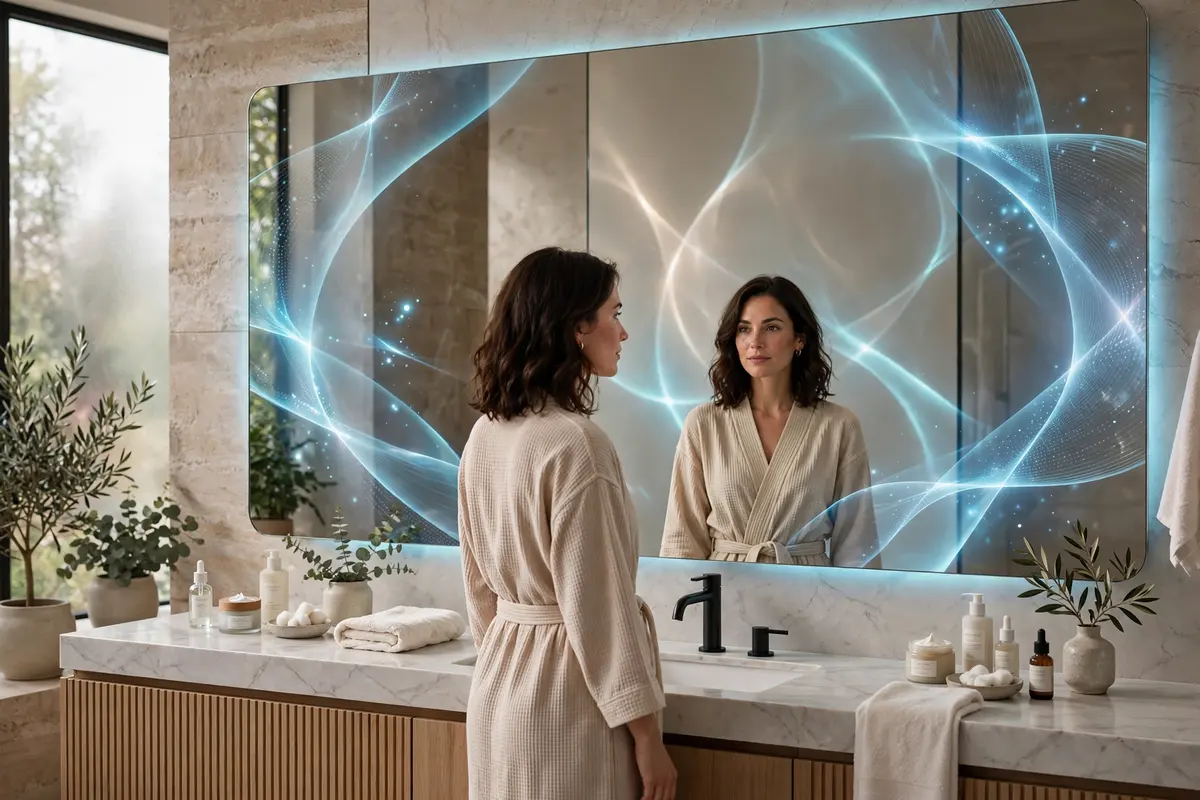
An AI smart mirror is a mirror with a display, camera and sensors built in. The reflective surface doubles as a screen, overlaying information on your reflection. Entry-level models show the time, weather and your calendar; beauty-focused models go much further, using the camera to analyse your skin each morning and presenting recommendations through the glass itself.
The concept belongs to the same family as the wider wave of at-home beauty technology — devices that bring analysis once confined to clinics and beauty counters into the home. Where a phone app requires you to open it and take a selfie, the smart beauty mirror works passively, at the moment you are already standing in front of it, which is precisely when skincare decisions get made.
Skin analysis in the mirror
The core beauty function is smart mirror skincare analysis. Under controlled lighting — important, because bathroom light is inconsistent — the mirror photographs your face and software assesses visible features: hydration clues, pigmentation, fine lines, pores, blemishes and redness. The underlying techniques are closely related to those used by standalone AI skin analysis tools, with the advantage that the mirror can repeat the process identically every day.
That repetition is the real breakthrough. A single skin reading is a snapshot; a month of readings is a trend. The mirror can show whether a new serum is visibly improving hydration, whether sun exposure has darkened pigmentation over a holiday, or whether a breakout cycle follows a pattern. Consistent measurement turns skincare from guesswork into something closer to an experiment you run on yourself.
Good mirrors also adapt their lighting, simulating daylight, office light or evening conditions so you can check how makeup will actually look where you are going — a small feature that solves a daily frustration. Some models keep separate profiles for different members of the household, so each person’s readings, products and progress stay distinct. As with the analysis itself, multi-user support underlines the shift: the mirror is becoming a shared piece of household health technology, closer to the bathroom scales than to a gadget, quietly collecting the kind of consistent data that makes its advice improve month after month.
Virtual try-on and personalised routines
Because the mirror knows your face, it can also show you things rather than just tell you. A virtual beauty mirror can preview makeup shades on your reflection — the same augmented reality approach as a phone-based virtual beauty try-on, but hands-free and at full-face scale, which makes judging a foundation match easier.
Routines become personalised in a more meaningful way, too. A personalised beauty mirror adjusts its suggestions to the day: heavier moisturiser when your skin reads dry, a reminder about SPF when the forecast is bright, a prompt to skip the strong exfoliant you used yesterday. Over time it learns your products, your skin’s responses and your goals, and the morning routine starts to resemble advice from someone who has watched your skin for months — because, in a sense, it has.
Connected mirrors and the Internet of Mirrors
Researchers have proposed going further, describing an “Internet of Mirrors” model in which a connected beauty mirror links with other devices and services: your hairstyling tools, your wearable’s sleep data, your local salon, even product reordering when a favourite item runs low. The same data-sharing logic is advancing in adjacent areas such as AI hair and hairstyle technology, where analysis of hair condition feeds product and styling advice.
Some of this is available now in simple forms — mirrors that sync with phone apps, share progress reports, or book appointments. The fuller vision, in which the mirror acts as a hub for your whole beauty and wellbeing routine, is still emerging. Whether it flourishes depends less on the technology than on whether people find the convenience worth the connectivity.
Privacy: a camera in the bathroom
Any honest assessment has to address the obvious concern: a smart mirror is a camera and microphone in the most private room of the house. Before buying, check what the manufacturer does with your images — whether analysis happens on the device or in the cloud, how long data is kept, whether it is shared, and whether the camera can be physically shuttered. Reputable makers are increasingly explicit about this, and on-device processing is becoming the selling point it deserves to be.
Practical habits help as well: place the mirror on your home network’s guest segment if you can, keep its software updated, and review its companion app permissions. The benefits of daily skin tracking are real, but they are not worth an always-on lens you do not control.
Should you buy one yet?
For most people, an AI smart mirror is still an early-adopter purchase: prices are high, and a good phone-based skin analysis app delivers much of the same guidance for far less. But for skincare enthusiasts who value consistent tracking, and for anyone who finds routines easier to keep when the advice appears in the glass each morning, the appeal is genuine. The mirror is evolving from a passive sheet of glass into an active participant in the beauty routine — and that shift, once complete, will not reverse.